Sewer Camera Inspection in Greer, SC
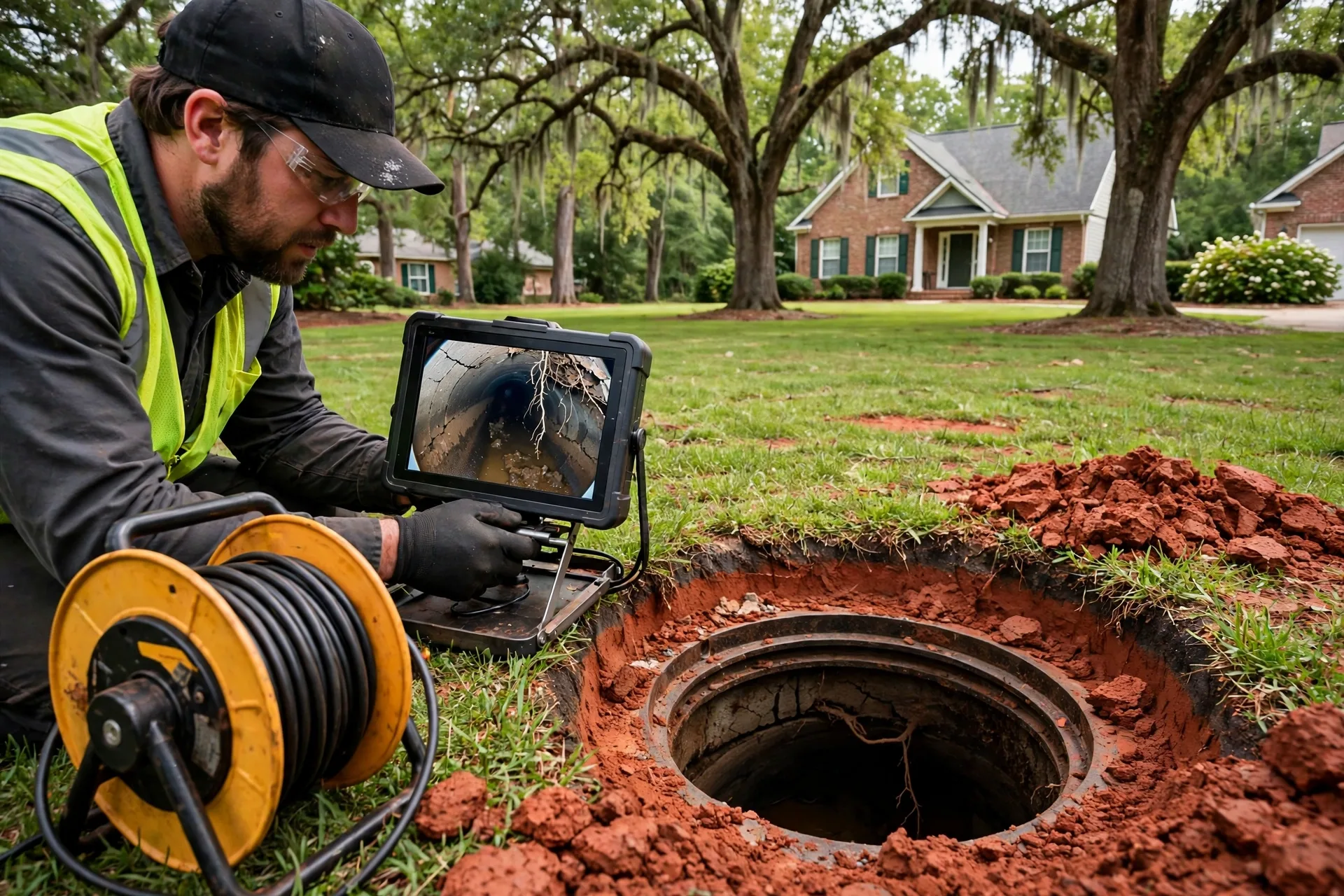
Short answer: a sewer camera inspection sends a waterproof camera through your line from the cleanout and records what's wrong — roots, cracks, a sag, a collapse, or nothing structural at all — along with its exact location and depth. In Greer it also settles who pays: your side of the cleanout is yours, the main beyond it is Greer CPW's. Published local cost: $150–$400.
Every bad sewer story in the research starts the same way: a big quote for a pipe nobody had seen. A professional sewer line inspection isn't a step in the sales process. It's the evidence every other decision on this site stands on, and the rule here is simple: footage first, opinions second.
At a Glance
- A waterproof camera travels your line from the cleanout and records the actual problem.
- It finds roots, cracks, sags and collapses — and pinpoints location and depth.
- In Greer it also settles who pays: your side of the cleanout, or CPW's main.
- Published local cost: $150–$400 (Modernize, Greer page).
- The footage is yours to keep — use it to compare any quote.
Inside Your Sewer Line — Tap the Hotspots
One run of pipe, four things a camera is looking for. Tap a marker:
Start with any marker. Each one is a finding a Greer camera inspection reports every week — and each points to a different fix.
- 1 · Roots: roots enter at a joint and grow into a net that catches paper and grease — the most common finding in Greer's older clay lines.
- 2 · Crack: a cracked or offset section lets soil and groundwater in and sewage out; one damaged section is usually a spot repair.
- 3 · Belly: a sagging section that holds water and sediment. Lining and bursting follow the old slope, so a belly needs that section excavated and re-bedded.
- 4 · Cleanout: the camera's entry point — and the boundary. Failures on the house side are the homeowner's; beyond it is CPW's main.
What the Camera Actually Finds
- Tree roots at joints — the #1 structural finding in Greer's established neighborhoods, where mature canopy sits over older clay and cast-iron laterals.
- Cracks, offsets, and corrosion — clay that has cracked, cast iron that has rotted through, joints shifted by clay-soil movement.
- Bellies — sagging sections holding water and sediment, obvious on camera with depth readings.
- Collapses and deformation — including Orangeburg fiber pipe gone soft and out of round in the 1950s–70s housing stock.
- The pipe's material and age profile — clay, cast iron, Orangeburg, or PVC; the single fact that most changes the recommendation.
- Grease, scale, and obstructions — the non-structural findings that mean cleaning, not repair.
- A clean bill of health — sometimes the line is sound and the camera talks a homeowner out of a repair.

The Footage Rule
Hold any company to this standard, this one included: you should see your own line. The problem area on screen, its distance from the cleanout, its depth — shown, not described.
With that footage, a second opinion becomes a like-for-like comparison, because the next contractor is pricing the same pictures. A quote built without an inspection is a sales number. A quote built on footage you can review is an estimate.
How an Inspection Runs
- Access at the cleanout — the capped access point on your line, typically toward the road in Greer.
- The run — the camera travels the lateral toward the street, recording continuously, with distance counted on screen.
- Locating — a locator above ground pinpoints each problem's position and depth, and places the failure on your side or CPW's side of the line.
- Review with you — findings explained at the screen: what it is, how bad it is, what it means.
- Written findings — what was found, where, and the options it supports, in a form you can hand to any contractor.
What an Inspection Costs — Published Ranges, Labelled
| Source | Published range | Scope |
|---|---|---|
| Modernize, Greer SC cost page | $150 – $400 | Greer-labelled aggregator estimates |
| HomeAdvisor cost guide | $100 – $500 | National cost-guide data |
Ask what your inspection includes before booking: the run itself, locating and depth readings, the footage, and written findings — and whether any fee is credited toward repair work. Full Greer cost guide.
The Greer Reason to Inspect First: The Cleanout Decides Who Pays
Under Greer CPW's published position, the homeowner owns the lateral from the house to the cleanout at the road; CPW owns the main beyond it. A camera run with a locator is the fastest way to place a failure on the correct side of that line. The full responsibility guide.
When to Book an Inspection
- A clog that keeps coming back — recurrence is a pipe symptom, not a cleaning schedule.
- Before approving any major repair quote — especially a five-figure one with no footage behind it.
- Buying a home in Greer — a quarter of the city's homes predate 1980, with clay, cast-iron, and Orangeburg-era lines.
- After a backup — to learn whether it was a blockage or a failure, before it repeats.
- Selling a home — documented line condition is a cleaner disclosure than a surprise at the buyer's inspection.
- A wet spot, smell, or gurgling that won't resolve.
Start with the cheapest certainty in the whole job: an inspection asks a few hundred for your own eyes — and in Greer, it also tells you whether the bill is even yours. Call Greer Sewer Pros: +1 (864) 874-0043
